
Challenging Bias
The past decade has not been particularly kind to diversifiers; a handful of large U.S. growth stocks generally outperformed international stocks, smaller companies and Value-oriented investments. As the gap widened, diversification may have looked less like prudent risk management and more like an unnecessary constraint. But recent strength across formerly lagging market segments offers a useful reminder that diversification’s greatest challenge remains squaring the intuition (more should be better) with the fact of narrow nearer-term outperformance:
- Diversification is not designed to maximize returns in every period but, rather, to reduce dependence on any single market outcome
- A properly diversified portfolio near always will contain holdings that appear disappointing in hindsight; the strongest arguments against diversification often emerge after a lengthy period of narrow market leadership
- Market leadership has historically changed over time, though the timing of those changes is unpredictable
- Not to identify tomorrow’s winner, among the goals of diversification is to improve the probability of achieving long-term financial objectives across a wide range of possible futures
Diversification’s Drawbacks
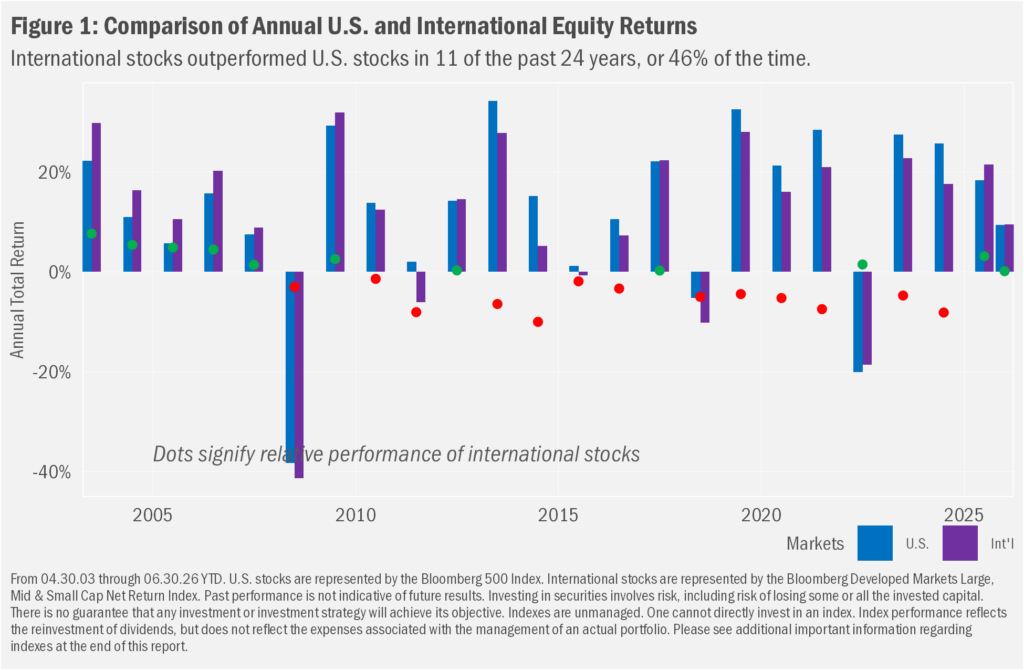
The past decade has been kind to equity investors. It has been kinder to investors with more concentrated portfolios—most notably those focused on the U.S. large-cap stocks represented by the S&P 500 Index—than to investors holding more diversified combinations of domestic and international stocks. In hindsight, there nearly always will have been a “better” portfolio to own. For U.S. investors in particular, who already enjoy efficient access to a large and widely diversified home market, international stocks can be especially difficult to defend when they lag for an extended period. We continue to emphasize that broader approach, even though the empirical case for diversification may appear less compelling after a decade of unusually narrow market leadership.
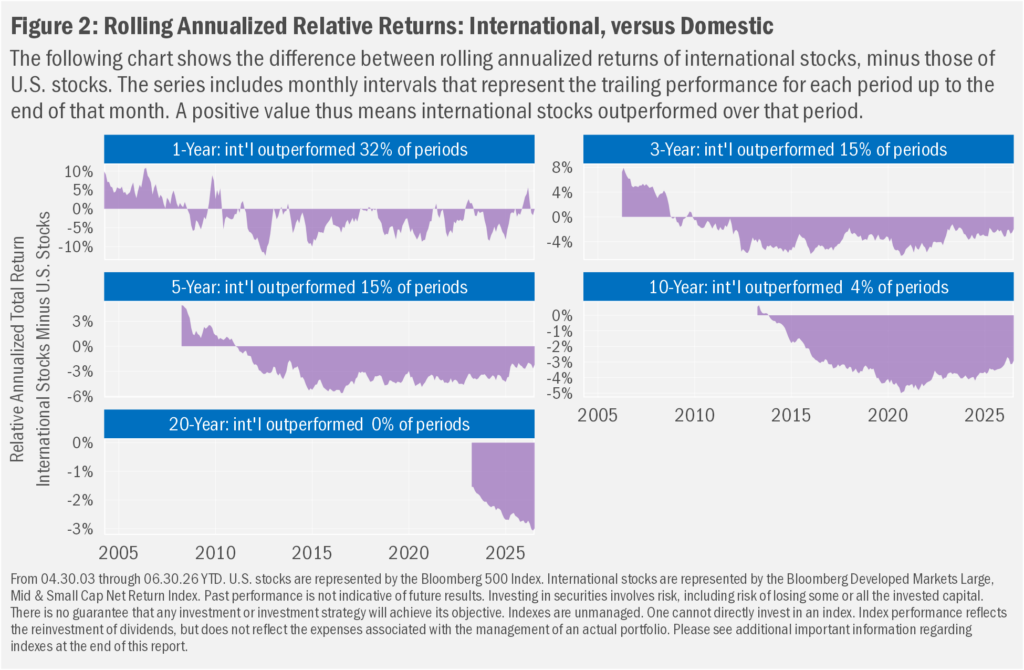
Since 2009, with relatively few exceptions, U.S. large-cap growth stocks have outpaced developed international markets on an annual return basis. Smaller companies also generally failed to keep pace. Value-oriented investments remained largely out of favor as investors paid increasingly high prices for realized growth and the promise of a continuation of recent trends. Against that backdrop, many investors found themselves asking a reasonable question: why own anything other than what has been working?
Hindsight Is No Guarantee
Investment decisions often are evaluated with the benefit of hindsight. Looking backward, it can seem obvious that a concentrated investment in the strongest-performing market segment would have been preferable to a more diversified allocation. But in 2015, few investors could have precisely identified the companies that would dominate market returns over the following decade. At the time, sentiment toward Nvidia (NVDA), in particular, was far less enthusiastic than later results would appear to justify. Coverage was concentrated on gaming and personal computer exposure, while artificial intelligence was mostly discounted and cryptocurrency mining was not yet a key component of the investment narrative. Although Nvidia eventually delivered the strongest performance among the group, a review of contemporaneous expectations suggests it may have been among the least appreciated of the companies that later became known as the Magnificent 7 [Alphabet (GOOG/GOOGL), Amazon (AMZN), Apple (AAPL), Meta (META), Microsoft (MSFT), Nvidia and Tesla (TSLA)].
The difficulty, of course, is that investors do not make decisions with the benefit of hindsight. They make them before the future unfolds, and the future often develops in ways that differ meaningfully from prevailing expectations. Recent performance across the Magnificent 7 offers a useful reminder. Several members of the group have roughly kept pace with, or even trailed, the broader market this year. Apple has been a notable exception. Once scolded for its lack of aggressive AI investment, the stock now seems to have found relative strength largely because the company took a slower, more thoughtful and defensible approach to investment in AI.
Even Nvidia has trailed the market as investors seemingly have begun to realize that there must be profit to come from all this investment in capacity for AI compute capacity, while they also may be glomming onto the idea that many (most?) of us might be better off investing in our own personal AI infrastructure (side note: we are editing this doc on a MacBook Pro, which we purchased seeking to test and eventually ensure we can safely take advantage of the remarkable capabilities that genAI tech can bring without compromising privacy and blowing up our tech budget).
So, the challenge is identifying market-beaters before they become winners, maintaining conviction long enough to benefit from being correct and getting out before sentiment and fundamentals shift. Diversification acknowledges that this task is extraordinarily difficult. Rather than attempting to identify a narrow set of future chart toppers, diversification seeks exposure to a broad range of potential outcomes. The tradeoff is obvious: a diversified portfolio will almost certainly own some investments that disappoint. It may be just as likely to own some that surprise positively. The objective is not to maximize returns in every period. The objective is to pursue attractive long-term returns while reducing the risk that a single error meaningfully derails a financial plan.
Cycles Cycle
The strongest arguments against diversification often emerge near the peak of a particularly dominant trend. By then, investors have become increasingly convinced that recent winners deserve larger allocations and that underperforming areas are no longer worth holding. History suggests such conclusions may be unwarranted. One of the recurring lessons of investment history is that leadership changes. The individual stocks, sectors, countries and investment styles that dominate one decade often look quite different from those that dominate the next. That does not mean market leadership changes on a predictable timetable. It does mean that investors should be cautious about assuming recent trends will continue indefinitely. The challenge is that timing those transitions is exceptionally difficult. Investors frequently abandon lagging investments shortly before performance improves and enthusiastically add to recent winners after much of the gain has already occurred. The result can be a cycle of buying high and selling low that gradually undermines long-term outcomes.
Balancing Breadth
A diversified approach will always be judged against the best-performing investment(s) over some trailing period. That comparison virtually guarantees disappointment for diversifiers. But while concentration can be rewarding, it can also dramatically increase the consequences of being wrong. One need not look too far into the past to see when shares in Nvidia lost two-thirds of their value on account of the reversal of the cryptocurrency mining trade.
Our preference for portfolios diversified across a range of exposures—asset classes, regions, currencies and individual security characteristics—accepts the possibility that not every holding will shine simultaneously. In exchange, it seeks to avoid excessive dependence on a single market segment, economic outcome or investment narrative. As U.S.-domiciled investors, we maintain relatively unique home-market characteristics that push against the more-can-be-better narrative. This fact generally supports our broader tilts toward U.S. stocks and bonds across all but the most aggressive portfolios we manage. Even so, our preference for broad diversification nods to the fact that equity market records represent a moment in the course of human history. The broader historical context shows that global, regional, macroeconomic and industrial supremacy ebbs and flows in manners hard to predict, in ways generally obtuse to the preferences and predictions of the contemporary hegemon.
Less dramatically, instead of attempting to identify the single best-performing asset class over the next ten years, investors should be seeking to fund retirements, support future spending needs, preserve purchasing power and maintain confidence through a wide range of market conditions. These objectives rarely require perfection. Rather, they require discipline, patience and a portfolio construction approach that acknowledges the limits of our ability to correctly predict the future.
Important Information
Statera Asset Management is a dba of Signature Resources Capital Management, LLC (SRCM). Signature Resources Capital Management, LLC (SRCM) is a registered investment adviser. Registration does not imply a certain level of skill or training. This material is provided for informational purposes only and should not be construed as investment advice or as an offer to buy or sell any security or implement any investment strategy. A decision to engage SRCM should be made only after carefully reviewing the applicable investment management agreement and SRCM’s Form ADV Part 2A and Part 2B, conducting any due diligence you consider appropriate, and consulting your legal, tax, and accounting advisors. All investing involves risk, including the possible loss of principal. Additional information regarding SRCM’s services, fees, risks, and conflicts of interest is available in the applicable investment management agreement and Form ADV. Information presented here is unaudited, subject to change, and intended only as a general guide to current views.
Past performance is not a guarantee of future results. The views expressed reflect SRCM’s opinions as of the date of writing, are subject to change, and may not reflect current thinking. This material is based on proprietary research and analysis, together with information believed to be reliable; however, SRCM does not represent that such information is accurate or complete and accepts no liability for any loss arising from its use. Certain content may be theoretical in nature and subject to inherent limitations. Any references to market exposures or specific investments are provided for illustrative purposes only and may or may not be reflected in client portfolios. No reader should assume that any investment or strategy discussed was or will be profitable. This material may also contain projections, targets, or other forward-looking statements based on current expectations and assumptions. These statements are not guarantees of future outcomes, and actual results may differ materially. You should consult your financial advisor to determine whether any investment or strategy is appropriate for your individual circumstances.
